Mark LeBlanc
Five Days at MemorialMark LeBlanc is the son of Vera LeBlanc and the husband of Sandra LeBlanc. After Hurricane Katrina left Memorial Medical Center without power and its patients awaiting evacuation, he and Sandra made their way back into the flooded city to reach Vera, a LifeCare patient. Their effort turned a family rescue into a practical challenge to the hospital’s evacuation system: they helped bring airboats to Memorial, offered to arrange transport, and ultimately carried Vera to a boat themselves. Mark’s actions place an individual family’s responsibility for a vulnerable patient against the institutional delays and triage decisions that shaped who could leave first.
Identity and Family Connection
Mark’s connection to Memorial predated the disaster. He had been born there when the hospital was known as Baptist, and it was the hospital his family had customarily used for care. He had visited Vera there shortly before Katrina. When the city flooded, she was not simply one patient among many to him: she was his mother, an eighty-two-year-old woman whose condition and location he knew personally.
Mark and Sandra had evacuated New Orleans before the storm and taken shelter with relatives in northern Louisiana. When they learned that the city had flooded, they set out to return, aiming to rescue Vera and her sitter. They first stopped in Baton Rouge to register as volunteers with the state’s emergency medical services and collect identification badges. Sandra’s experience administering state EMT examinations gave her some familiarity with the system, but the couple still had to find a workable way into the city and to the hospital.
Finding a Route to Memorial
At the volunteer staging point, Mark and Sandra asked about Memorial and another hospital. They learned that Memorial was being placed late in the hospital-prioritization order, though the person addressing them could not explain why. The couple knew the decision did not match what they understood about conditions at Memorial: the hospital had lost power, people were desperate, and patients were in danger. The unanswered questions about responsibility and rescue did not produce a clear official route forward.
Two airboat pilots asked whether the LeBlancs knew how to reach Memorial. Mark could guide them: he knew the hospital from his own birth and his family’s history there. The group explored a possible route, then found floodwater on Jefferson Highway just east of Ochsner Medical Center, near the railroad tracks and the Orleans Parish line. From there, the LeBlancs explained, the route ran toward Memorial along the highway, which became Claiborne Avenue. It was the same route they had taken in the opposite direction when evacuating days earlier.
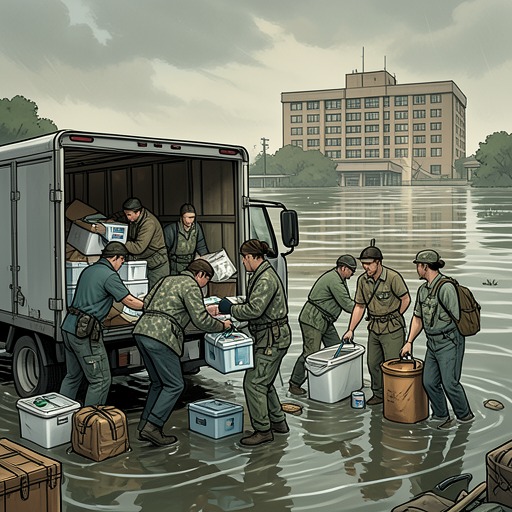
The pilots launched their boats from the flooded highway. As the group crossed into the city, they passed people standing in deep water and signaling for help. The LeBlancs told them that dry ground lay in another direction, but that the boats were continuing to the hospital. At Memorial, the sight of the rescue craft drew a crowd to the windows and ambulance ramp. The arrival offered a means of access that the usual evacuation channels had not provided, but it did not by itself solve how to move patients from the hospital to the boats and onward to care.
Reaching Vera and Seeking Help
Mark borrowed a flashlight from a nurse and climbed seven flights to LifeCare. He found Vera in a hot, still ward, lying on a wet bed and covered in sweat. She smiled at him and said she was thirsty. Mark was angry at the condition in which he found her. He went to get Sandra, and together they comforted Vera before looking for someone who could explain what was happening and arrange her evacuation.
They spoke with Diane Robichaux, the visibly pregnant senior leader on the floor. Robichaux said she had little information. The LeBlancs explained that airboats were available and described a place near the railroad tracks where patients could be dropped off, but ambulances would be needed there to continue the evacuation. Robichaux could no longer reach her corporate office to request them. The couple offered to try using their working cell phone, and Robichaux accepted their help.
The attempt revealed how fragile the transfer chain was. An ambulance company would not send vehicles without an exact address; the hospital could identify the boat location but not provide the requested street address. While staff searched for a usable address or cross street, the call dropped, and Robichaux could not reconnect. She did reach a LifeCare representative in Shreveport, who said she would try to redirect ambulances to the boat location and help locate ventilator patients who had already been evacuated. Mark and Sandra had brought transport close to the hospital, but coordinating the next leg remained difficult.
Mark also objected to what he saw as inadequate treatment for Vera. He believed she needed intravenous fluids for hydration and antibiotics for a persistent urinary infection, but he had been told that intravenous fluids were no longer available. Although Vera was a LifeCare patient, he raised the concern with a Memorial administrator. The explanation was that Memorial had shifted into survival mode rather than continuing to function as a treating hospital. Mark questioned the implication of that change: the hospital’s emergency posture, as he encountered it, meant that care his mother needed was no longer being provided.
Evacuation Order and Family Action
By Wednesday morning, staff were sorting more than one hundred remaining Memorial and LifeCare patients into three evacuation groups. Patients able to sit or walk were classified as group one and prioritized first; sicker patients needing more help were group two; and those considered very ill, along with patients with DNR orders, were placed in group three for evacuation last. Vera had a DNR order that she had requested more than a decade earlier, so that her heart would not be restarted if it stopped. It was not a new decision by a woman then dying, and her heart was still beating. Yet the order placed her in the last group, away from the head of the line.
By late afternoon, few patients had left Memorial. Helicopters had landed only rarely, and ambulances had not arrived at the boat drop-off. Sandra found Mark with Vera in the second-floor lobby and urged that they get his mother out. Vera’s hospital gown bore the family names and phone numbers Mark and Sandra had written on it after they had been told she would leave by helicopter. Instead, she remained near an ATM and a planter, still waiting with other patients marked DNR.
A staff member had earlier tried to prevent the couple from entering the patient-care area. Mark and Sandra gained access by making clear that they could take away the boats they had brought. The boats were running low on fuel, the pilots had heard reports of gunfire at rescuers, and the volunteers did not plan to return the next day, although many people remained at Memorial. When Sandra learned that no more helicopters would come that day, the couple decided not to leave Vera for another night in the hospital.
They lifted the ends of her cot to carry her downstairs, but the cot bent under her weight and they had to adjust their grip. Several doctors told them they could not take her. Sandra insisted that the doctors either help or move aside. Their decision confronted the practical force of the evacuation order: a patient placed last in the queue could remain behind even when family members had secured a possible means of leaving. With two volunteers’ help, Mark and Sandra carried Vera down to the ambulance ramp and lifted her through an opening where a pane of Plexiglas had been removed. They fitted her with earmuffs and placed her aboard an airboat.
Narrative Role and Significance
Mark’s story is defined by a sequence of practical efforts rather than authority within the hospital: returning to the city, guiding rescuers, finding his mother, trying to secure ambulances, and carrying her out. Each step exposes a different gap between the presence of a rescue resource and a completed evacuation. Airboats reached Memorial, but patients still needed to be brought downstairs; a location for ambulance pickup was known, but the lack of an exact address obstructed dispatch; and a helicopter promise did not result in Vera leaving. The family’s intervention ultimately supplied the movement that the system had not delivered for her.
His conflict with the hospital’s triage arrangement is specific to Vera’s circumstances. Her old DNR request concerned resuscitation if her heart stopped, not a wish to forgo evacuation or a judgment that her life should be deprioritized. Mark’s actions make visible the difference between a medical instruction about resuscitation and a broader decision about who receives rescue first. The account ends with Vera aboard the boat, a concrete departure from the hospital, while leaving the subsequent course of her evacuation outside the events shown here.